
Body groomer or razor – which system makes sense?
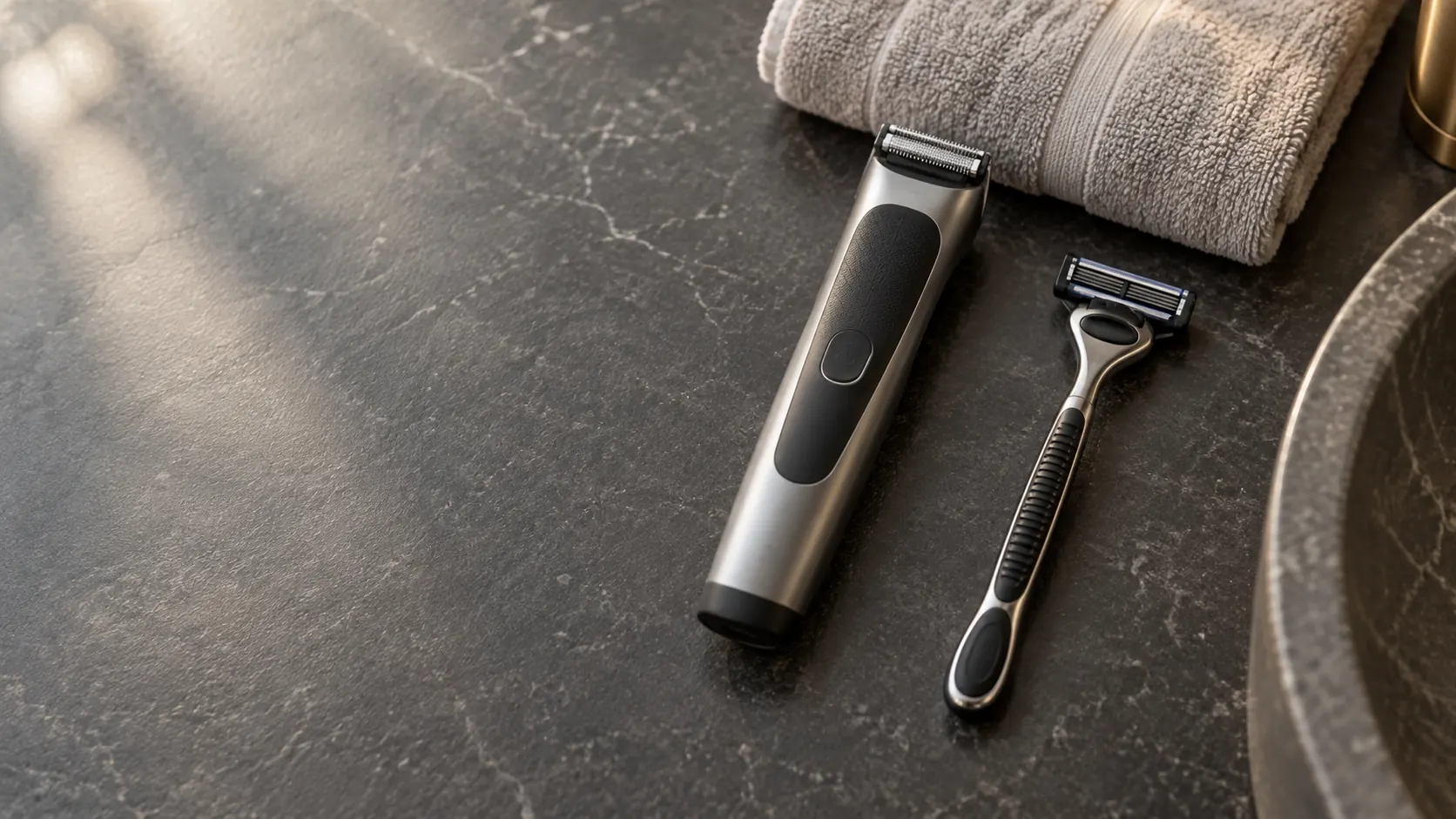
The short answer: a razor removes hair at skin level, a body groomer shortens it to an even length. If you want skin that feels smooth to the touch, you need a razor. If you want body hair that looks tidy without the regrowth stubble and the irritation, a body groomer does the job better – and faster on large areas.
Most men who groom regularly end up using both: the groomer every week or two, the razor only when a genuinely smooth result matters. The sections below cover what each system actually does to the hair and the skin, how they differ by body area, and what to look at before you buy.
What each system does to the hair
A body groomer cuts hair above the skin. Without a guard comb most models leave roughly 0.5 to 1 mm – short enough to read as groomed rather than hairy. With guard combs you set a defined length, usually from about 3 mm upwards. The blade never touches the skin directly, which is the whole point of the design.
A razor cuts at or just below skin level. A cartridge razor does this with several blades in one pass, an electric foil or rotary shaver with a cutting element behind a thin screen. The result is smooth to the touch – and it is the direct blade-to-skin contact that causes most of the problems people associate with body shaving.
The differences that actually matter
| Body groomer | Razor | |
|---|---|---|
| Result | Even short length, hair stays visible | Smooth to the touch |
| Regrowth | Grows back unnoticed | Sharp stubble after two to three days |
| Skin irritation | Low – no blade contact | Razor burn and ingrown hairs are common |
| Large areas | Fast, wide cutting head | Slow, many passes |
| Hard-to-reach spots | Manageable alone | Back usually needs help |
| Wet or dry | Mostly both | Cartridge razors need water and gel |
| Running costs | Blade block lasts years | Replacement cartridges or foils |
| Interval | Every one to two weeks | Every two to three days for a smooth look |
Body groomer or razor, by body area
Chest and stomach
This is where the groomer wins most clearly. Dense chest hair trimmed to an even length looks deliberate, and there is no itchy phase while it grows back. Shaved chest skin is also more sensitive than most people expect – the regrowth against a shirt is what usually ends the experiment.
Go for the razor only if you want the chest genuinely smooth and are willing to repeat it every few days.
Back and shoulders
A groomer with a wide cutting head, ideally with a long handle attachment, is the practical option here. You can reach most of your own back and you are not working blind with a blade. Shaving your own back is difficult, and the risk of nicks on the shoulder blades is real.
Legs
Decide by the result you want. Smooth legs – for cycling, swimming or simply preference – means a razor. If you only want to take the density down, a groomer does the whole lower leg in a couple of minutes and leaves nothing to grow back sharply.
Underarms
Trimming rather than shaving reduces friction and holds odour less, and it avoids the irritation that deodorant on freshly shaved skin causes. A short guard comb is usually enough.
Sensitive and intimate areas
Use a device made for it. Body groomers for these zones have rounded blade tips and skin guards so the cutting edge cannot reach the skin. Shaving here gives the smoothest result but also the highest rate of ingrown hairs and razor bumps – it is the one area where the comfort argument is strongest.
Why trimming is easier on the skin
Razor burn, red bumps and ingrown hairs nearly all trace back to the same cause: the hair is cut at or below skin level and then has to push back through. On body hair, which is often coarser and curlier than facial hair, that regrowth curls back into the skin more readily.
A groomer leaves the hair just long enough that it never has to break back out. That is the reason it is usually recommended for sensitive skin, for anyone who gets ingrown hairs, and for areas that sit under clothing all day.
If you do shave, the basics matter: a sharp blade, warm skin, a proper gel rather than soap, shaving with the grain first, and a fragrance-free aftercare product. A blunt blade causes far more irritation than the shaving itself.
Cleaning, blades and what it costs over time
Most body groomers can be rinsed under running water; the cutting block is a wearing part but lasts years with normal use. That makes the running costs close to zero after the purchase.
Cartridge razors are the opposite: cheap to start with, and then a permanent cost in blades – and a blade that is used too long is precisely what causes irritation. Electric shavers sit in between, with foils and cutters that are replaced every one to two years.
What to look at before you buy
- Cutting width – a wide head saves real time on chest, back and legs.
- Guard combs – how short the shortest setting is, and whether the lengths you want are included.
- Skin protection – rounded blade tips are what make a device suitable for sensitive zones.
- Wet use – fully washable means you can work in the shower and clean it properly.
- Battery and charging – runtime matters less than whether it can run while plugged in.
- Grip – it has to stay in your hand with wet fingers and at awkward angles.
- All-in-one or specialist – one device for head, face and body is convenient; separate heads for the body are usually more comfortable.
Conclusion – smoothness or comfort?
Pick the razor if the result you want is smooth skin and you accept the upkeep that comes with it. Pick the body groomer if you want body hair kept in order with the least irritation and the least effort – which for most areas, and most people, is the more realistic choice.
The combination is not a compromise but the normal case: the groomer for regular maintenance, the razor for the occasions when smooth is the point.
The devices that go with this
If you want to trim rather than shave – keeping some length and avoiding irritation:
- Wahl GroomsMan Battery All-in-One Trimmer
- Wahl Body Groomer 9953-1016 Groomsman Body
- Wahl All-In-One Multigroomer for head, face and body
If you want it properly smooth:
- Wahl All in One Shaver 9880-116 with lithium-ion battery
The full selection is under All-in-One Trimmers. For the aftercare – against redness and ingrown hairs – look at Shaving care.
Frequently asked questions about body groomer or razor
Is a body groomer better than a razor?
A body groomer is better suited for regular body hair maintenance with less risk of irritation. A razor is better for completely smooth skin.
Can you get completely smooth skin with a body groomer?
Most body groomers trim very short, but do not remove hair fully at skin level. For maximum smoothness, a razor is better.
Is a body groomer suitable for intimate areas?
Many body groomers are designed for sensitive zones. Models with skin protection reduce the risk of nicks and irritation.
Which is more skin-friendly – a body groomer or a razor?
A body groomer is usually considered more skin-friendly because there is less direct blade contact with the skin.
What is better for chest hair?
For chest hair, a body groomer is often more comfortable because it trims evenly and helps reduce irritation. For full smoothness, a razor is better.
Can a razor replace a body groomer?
A razor can remove hair, but it is less comfortable on larger areas. For regular body grooming, a body groomer is usually more practical.
How often should you trim body hair?
That depends on hair growth and the desired result. Many users trim body hair every one to two weeks.
Is an electric body groomer better than wet shaving?
An electric body groomer often reduces irritation and is very suitable for regular grooming. Wet shaving provides a smoother finish.